

Understanding the challenges in roofing scheduling
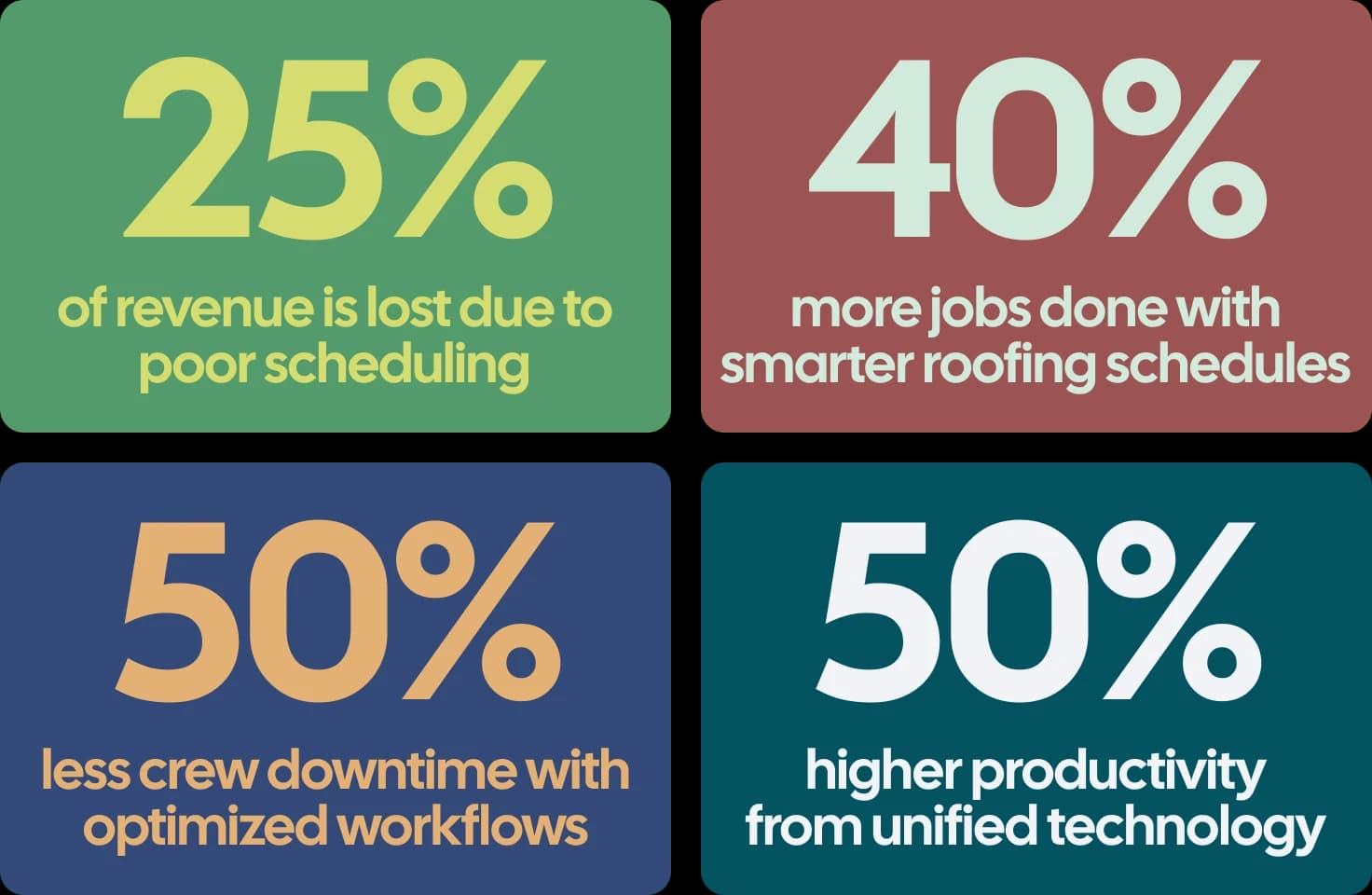
The roofing industry is uniquely demanding. Jobs are weather-dependent, labor-intensive, and often unpredictable. Traditional scheduling methods—relying on spreadsheets, phone calls, and gut feelings—lead to inefficiencies like idle crews, missed opportunities, and frustrated clients. According to a 2023 report from the National Roofing Contractors Association (NRCA), average roofing companies lose up to 25% of potential revenue due to poor scheduling alone.
Common pain points
Weather variability: Sudden rain can derail a week's worth of plans, leaving crews unproductive.
Crew utilization: Without precise roofing crew optimization, workers spend more time traveling than roofing.
Client expectations: Delays erode trust, leading to lost referrals in a word-of-mouth-driven market.
Resource allocation: Materials and equipment often sit idle, tying up capital.
Top companies overcome these by adopting a data-driven approach to roofing productivity tips. They treat scheduling as a science, not an art, integrating forecasts, GPS tracking, and automation to predict and prevent disruptions.
The 40% efficiency benchmark
Industry benchmarks show that elite roofing firms achieve 40% higher job throughput by focusing on three pillars: predictive planning, real-time adjustments, and team empowerment. This isn't about working harder; it's about working smarter to maximize every hour.
Metric | Average company | Top performer | Improvement potential |
|---|---|---|---|
Jobs per crew per week | 2-3 | 4-5 | 40%+ |
Crew idle time | 20-30% | <10% | Reduce by 50% |
Revenue per employee | $150K/year | $210K/year | 40% Growth |
For further reading on industry stats, check the Roofing Contractor Magazine's annual efficiency survey.

Proven strategies for scheduling more roofing jobs
To schedule more roofing jobs without expanding your team, top roofing companies implement layered strategies that build on each other. These focus on foresight, flexibility, and feedback loops to ensure seamless roofing job management.
1. Implement predictive scheduling
Predictive scheduling uses historical data, weather APIs, and AI to forecast optimal job timelines. Instead of reactive planning, companies like those featured in roofing business growth case studies plan months ahead.
Weather integration: Tools like WeatherAPI pull real-time forecasts to slot indoor prep work during rainy spells.
Job batching: Group similar jobs (e.g., shingle replacements) by geography to cut travel time by 30%.
Seasonal buffering: Build in 10-15% buffer time for peak seasons, preventing burnout.
Result? Crews stay busy 90% of the time, directly contributing to that 40% uptick in jobs.
2. Optimize route and resource planning
Roofing crew optimization starts with logistics. GPS-enabled software maps efficient routes, ensuring crews hit multiple sites daily without overlap.
Assess daily capacity: Calculate travel, setup, and execution times per job type.
Use clustering algorithms to assign jobs within a 20-mile radius.
Track fuel and vehicle maintenance to minimize downtime.
For route optimization tools, explore Route4Me's roofing-specific solutions, which have helped users reduce mileage by 25%. Workiz also includes a route builder attached to the tech daily calendar that auto-updates as job are being added to you business management panel. Learn more about Workiz Automations.
3. Foster cross-training and skill versatility
Versatile crews handle diverse tasks, from inspections to repairs, without waiting for specialists. Top firms invest in ongoing training, certifying workers in multiple areas like metal roofing and solar installations.
Weekly skill drills: Rotate roles to build redundancy.
Certification incentives: Boost morale and capability with bonuses for new quals.
Hybrid job packaging: Combine small repairs with larger installs for fuller days.
This approach not only schedules more jobs but enhances roofing productivity tips by reducing bottlenecks.
Workflow optimizations for roofing crew optimization
Beyond tools, it's about refining processes. Top companies redesign workflows to eliminate waste, drawing from lean manufacturing principles adapted for construction.
Standardizing job processes
Create templated workflows for common jobs: inspections, repairs, full replacements. This ensures consistency and speeds up execution.
Pre-job checklists: Verify materials and permits 24 hours prior.
Daily huddles: 10-minute stand-ups to align on priorities.
Post-job reviews: Capture lessons to refine future schedules.
Standardization alone can boost roofing productivity tips by 15-20%, as crews move faster through familiar steps.
Leveraging subcontractors strategically
Without hiring full-time, partner with vetted subs for overflow. Use platforms like Angi Pro to find reliable specialists, maintaining quality while scaling volume.
Clear contracts: Define scopes to avoid disputes.
Performance tracking: Rate subs on time and quality for repeat business.
Hybrid crews: Mix core team with subs for peak loads.
Client onboarding and communication
Efficient scheduling extends to clients. Automated emails and portals keep them informed, reducing inquiries and enabling self-scheduling for small jobs.

Case studies: Real-world success in roofing business growth
Let's look at how these strategies play out. These anonymized examples from top firms illustrate the 40% job increase in action.
Names are different, the experiences are genuine.
Case study 1: Midwest Roofing Inc.
A 20-crew operation in Ohio struggled with seasonal slumps. By adopting Jobber for predictive scheduling and cross-training, they batched jobs geographically and integrated weather data. Result: Jobs per week rose from 35 to 50—a 43% jump—without new hires. Revenue grew 35% in year one.
Key takeaway: Data-driven planning turned weather from foe to ally.
Case study 2: Coastal Elite Roofers
Facing hurricane-prone delays in Florida, this firm used AccuLynx for real-time tracking and AR estimates. They optimized routes via GPS, reducing travel by 28%. Crew versatility allowed handling repairs alongside installs. Outcome: 40% more jobs scheduled, with 15% profit margin improvement.
Before: 60% utilization rate.
After: 92% utilization, minimal idle time.
Industry-wide insights
A study by the Associated General Contractors of America (AGC) highlights that firms using integrated tech see 30-50% efficiency gains. For more cases, read this Roofing Contractor article.
Company | Strategy implemented | Job increase | ROI timeline |
|---|---|---|---|
Midwest Roofing | Predictive Scheduling + Training | 43% | 6 months |
Coastal Elite | Tech Integration + Routing | 40% | 4 months |
Step-by-step implementation guide
Ready to apply these? Follow this roadmap to achieve roofing business efficiency.
Phase 1: Assess current operations (weeks 1-2)
Audit your schedules: Track a month's jobs for idle time, travel, and delays. Use free tools like Google Sheets initially.
Phase 2: Select and integrate tools (weeks 3-4)
Choose one scheduling software based on your size. Pilot with one crew, then scale.
Phase 3: Train and optimize workflows (weeks 5-8)
Conduct workshops on new processes. Monitor KPIs weekly: utilization rate, jobs completed, client satisfaction.
Phase 4: Measure and iterate (Ongoing)
Set quarterly reviews. Adjust based on data—aim for that 40% milestone within six months.
KPIs to track: Jobs per crew, revenue per job, crew hours billed.
Common pitfalls: Resist change; undertrain staff; ignore feedback.
For templates, download free resources from NRCA's efficiency toolkit.
Conclusion: Scaling your roofing business sustainably
Mastering roofing company scheduling isn't about adding headcount—it's about unlocking the full potential of your existing team. By embracing predictive strategies, leveraging technology, and refining workflows, top roofing companies consistently schedule more roofing jobs, driving roofing business growth and profitability. The 40% efficiency gain is achievable for any dedicated operation, leading to happier crews, satisfied clients, and a competitive edge.
As the industry evolves with green roofing and smart homes, those who prioritize roofing productivity tips and roofing job management will thrive. Start small: Pick one strategy today, measure results, and build from there. Your path to sustainable success begins now.
Frequently asked questions
Predictive scheduling brings significant advantages to roofing companies by combining data analysis, automation, and workforce management tools to optimize how and when jobs are scheduled. The main benefits include:
Improved resource allocation Predictive tools analyze past projects, crew availability, and weather forecasts to assign the right team and materials for each job. This reduces idle time and minimizes wasted trips or rescheduling due to unforeseen conditions.
Higher customer satisfaction By predicting accurate timelines and minimizing cancellations or delays, roofing companies can provide customers with reliable service dates. This builds trust and helps generate positive reviews and referrals.
Reduced downtime and weather delays Roof work is heavily affected by weather. Predictive scheduling integrates weather data to proactively plan around rain or wind, keeping projects moving efficiently while maintaining worker safety.
Enhanced profit margins Predicting which jobs are most profitable and scheduling them during peak productivity periods helps maximize revenue. It also reduces overtime costs and last-minute labor expenses.
Data-driven decision making Predictive analytics provide insights into seasonal demand, job durations, and material usage patterns. This allows managers to make informed decisions about inventory, staffing, and marketing.
Compliance and labor optimization Automated scheduling helps ensure compliance with labor laws and union rules while balancing workloads across teams—reducing burnout and turnover.
Competitive advantage Roofing companies using predictive scheduling stand out with faster response times, efficient planning, and transparent communication, giving them an edge in local markets.
Roofing companies should evaluate scheduling software based on how well it fits their operations, team size, and growth goals.
Identify Business Needs
Prioritize Key Features
Check Ease of Use and Support
Ensure Scalability
Evaluate Cost vs. Value
Test Before Buying
Weather plays a critical role in roofing operations, directly affecting project timelines, crew safety, and material performance. Roofing companies must adapt their schedules based on local climate patterns and seasonal changes to maintain efficiency and profitability.
1. Impact of weather variability
Different weather conditions can halt or delay roofing work depending on severity, frequency, and timing.
Weather condition
Impact on roofing operations
Common issues
Rain
Stops most roof installations due to wet surfaces and adhesive failure risk
Leaks, unsafe footing, damaged materials
Extreme heat
Shortens work hours; affects asphalt shingles and worker safety
Material softening, heat stress
Cold & snow
Makes shingles brittle; complicates sealing and drying
Cracking, ice buildup, project delays
High winds
Dangerous for open-roof work; delays material placement
Safety hazards, blown-off materials
Humidity
Affects adhesive and coating applications
Improper sealing, longer drying times
2. Seasonal scheduling overview by region
Region
Peak roofing season
Weather challenges
Recommended strategies
Northeast (U.S.)
April–October
Snow and freezing temps in winter
Front-load projects in spring/summer; use predictive weather tools
Southeast (U.S.)
March–November
Heavy rain and hurricanes
Flexible scheduling; monitor tropical storm forecasts
Midwest (U.S.)
May–September
Sudden storms, cold winters
Cluster jobs by location; maintain backup indoor work
Southwest (U.S.)
Year-round with summer heat breaks
Extreme heat
Schedule early-morning or night shifts; provide cooling periods
West Coast (U.S.)
April–November
Occasional rain, wildfires
Maintain seasonal flexibility; use fire-resistant materials where applicable
Scheduling – Lets you assign roof inspections, installations, and repair jobs efficiently, avoiding overlaps and ensuring crews are where they need to be on time.
Estimates & Proposals – Helps roofers quickly create detailed quotes for homeowners, including labor, materials, and optional upgrades, boosting professionalism and sales.
Invoicing – Simplifies billing and payment collection after a roofing job, ensuring cash flow is steady and paperwork is reduced.
Client CRM – Keeps track of each client's property history, roof type, and service records, helping with repeat maintenance and warranty follow-ups.
Automations – Enables automatic reminders for scheduled inspections, payment follow-ups, and maintenance check-ins, saving time and reducing missed opportunities.